


Stop me if you've heard this one before. Two men go on a trip abroad to a place where they clearly do not belong. Once there, they cause nothing but trouble for everyone around them, leaving many to wonder why they bothered to come at all. The men mostly seem to hate each other, expressing those feelings through foul-mouthed insults and repeated demands to shut the fuck up. Yet beneath all the cursing and hostility, they are just a pair of misfits who need and deserve each other more than they realize. Their hard-shelled exteriors eventually melt away, revealing a redemptive gentleness that an act of violence forces them to decide whether they want to preserve.
If all that sounds familiar, then congratulations, you've probably seen a few films by Martin McDonagh. The British-born Irish writer-director has never been one to venture far outside his wheelhouse. All his films feature generally unpleasant characters who are either prone to violence or find themselves caught in violent situations. The humor is crude, the tone morbidly comedic. Fellow Irishmen Colin Farrell and Brendan Gleeson played a disagreeable pair of friends in In Bruges and The Banshees of Inisherin, while Frances McDormand exacted rage-fueled revenge against Sam Rockwell and Woody Harrelson in Three Billboards Outside Ebbing, Missouri.
Marking his third cinematic collaboration with McDonagh, Rockwell plays Lee, a CIA agent stationed in Chile circa 1973. Working alongside fellow agent Chris (John Malkovich) under bureau chief MJ (Steve Buscemi), he has been tasked with orchestrating a coup d'état to overthrow the democratically elected socialist president Salvador Allende and replace him with General Augusto Pinochet. Despite being a ruthless dictator who was literally portrayed as a vampire to the Chilean people in Pablo Larraín's El Conde, Pinochet poses a far smaller threat to the foreign interests of the United States. The operation involves spying on student protest groups, orchestrating disruptions at local masses, and doing anything else that might stoke dissent among the population. As hinted at in the opening conversation between Chris and Lee, this isn't the first time they've done this sort of thing. Countries such as Congo, Grenada, Cuba, and Iran are all referenced. Wherever they go, the house of cards begins to tumble.
Normally, that would be bad news for the people of Easter Island, locally known as Rapa Nui, a small island roughly 2,000 miles west of Chile and home to hundreds of the famous giant stone heads, or moai. But this particular venture is meant to be a vacation for the pair before things go south in Santiago, as well as a farewell retirement trip for Chris. He is retiring from life as well, as a terminal cancer diagnosis has left him with only a week to live. That effectively gives him permission to stop caring, as he openly tells two Chilean students (Mariana Di Girolamo and Ailín Salas) that he's part of the CIA and that their country is headed for disaster. As much as Lee wants to make his friend's final days comfortable, he also must ensure Chris doesn't reveal too many secrets, or he'll have to stop him by any means necessary.
One aspect of Chris's take-no-prisoners attitude is his determination to record his memoirs on tape. It's a nearly identical beat to Malkovich's character in Joel and Ethan Coen's Burn After Reading, where he played a bumbling CIA analyst nearing the end of his career. McDonagh's film shares many of that movie's themes, portraying America's premier intelligence agency as a house full of fools, alcoholics, and junkies. As funny as it is to laugh at them, they were the ones shaping the world, and millions suffered because of it. McDonagh recognizes that Americans don't typically care about other people's problems, so he turns the lens back on them by hinting at Chris's involvement in a certain assassination that took place in Dallas.
The audience never has to suffer through the film, however, as this might be McDonagh's funniest work yet. The jokes may not be as character-driven or emotionally resonant as those in In Bruges or The Banshees of Inisherin, but they are hilarious, nonetheless. At one point, Chris launches into a long-winded tirade about how the more democratic a country becomes, the gayer it becomes, which in turn means it makes better cheese. France and Italy, he argues, are more democratic than the Scandinavian countries, which is why they're gayer and produce better cheese. Having an actor as specific and singular as Malkovich delivering these lines makes the entire sequence even funnier, while Rockwell proves equally precise with his reactions and retorts.
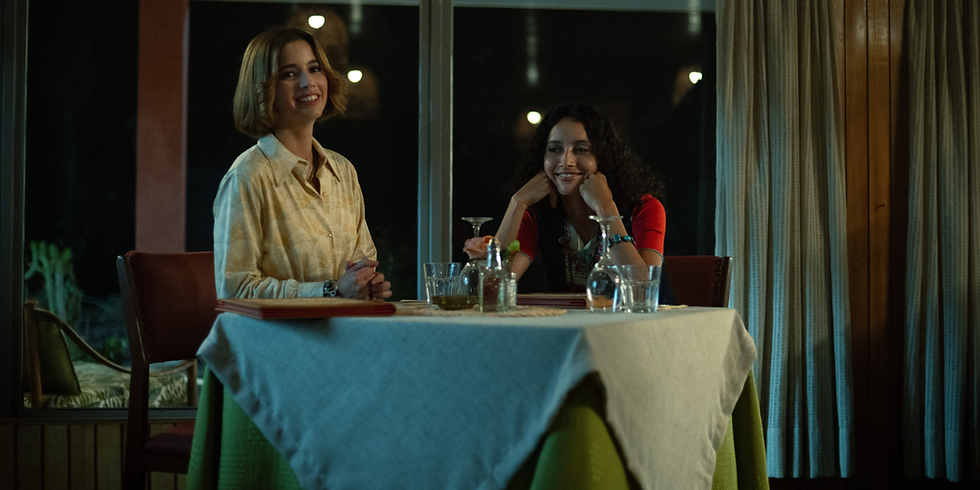
Despite being on the opposite side of the world, Easter Island looks an awful lot like the cliffs of Ireland. McDonagh reunites most of the crew from The Banshees of Inisherin, including cinematographer Ben Davis. Working alongside production designer Denis Schnegg, Davis blends the decade's fascination with browns and yellows with the vibrant greens of the island countryside. Editor Mikkel E.G. Nielsen and composer Carter Burwell combine to strike a tone of whimsy and melancholy, much like the conversations between Chris and Lee, which can shift effortlessly from compassionate to cutting.
The title comes from the friends' observation of nine wild horses that roam the island, often bringing everything else to a standstill. One night, under the influence of alcohol and regret, Chris comes face-to-face with one of them. However majestic these creatures may be, their large pupils create an unsettling emptiness. To look a horse in the eye is to see yourself reflected. For Chris, a stand-in for America's role throughout much of the 20th century, a period when diplomacy was often conducted at gunpoint, it is not a pleasant sight. Sometimes it takes an outsider to hold up that mirror, all while doing so with such barbed humor.
This review was originally published from the Canadian premiere at the 2026 Toronto International Film Festival. Searchlight Pictures will release Wild Horse Nine in theaters nationwide on November 06th.
Wild Horse Nine

November 2, 2026
By:
Hunter Friesen
The Mosquito Bowl

October 28, 2026
By:
Hunter Friesen
The Only Living Pickpocket in NY

October 26, 2026
By:
Hunter Friesen
Wildwood